Last updated: 17 May 2026 · Written by Lucy Cameron
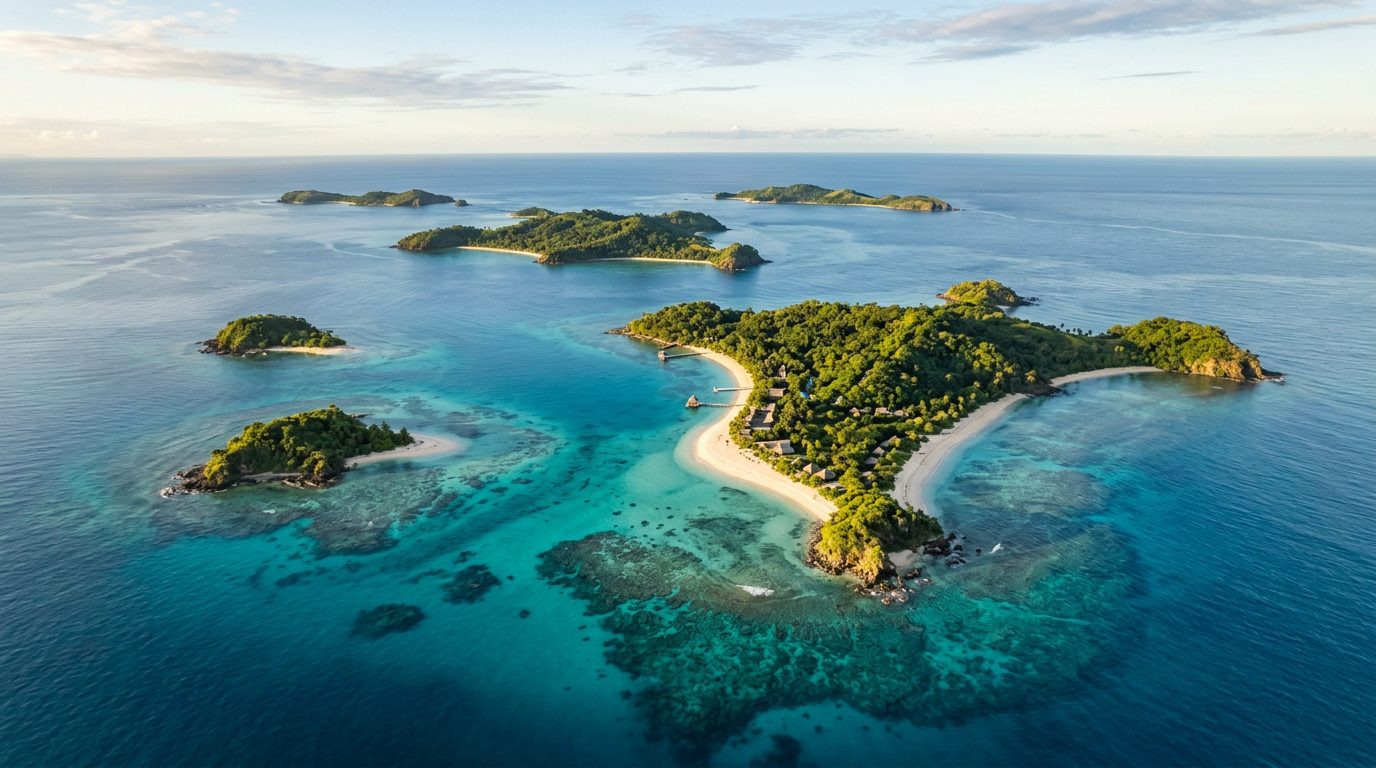
The Fiji islands are a constellation of 333 named islands spread across the South Pacific — and most travellers only ever visit two or three of them. After fifteen trips since 2017, we have learned that the difference between a good Fiji holiday and a great one usually comes down to picking the right island for the kind of trip you actually want.
Key Takeaways
- Fiji has 333 islands grouped into 8 major regions — but most visitors split time between the Mamanuca, Yasawa, and Coral Coast regions of Viti Levu.
- Pick Mamanucas for short transfers and overwater bures, Yasawas for island-hopping and backpackers, and Coral Coast for family resorts and budget flexibility.
- The two harder-to-reach islands worth a second trip: Taveuni (Garden Island, world-class diving) and Vanua Levu (Savusavu, deep-water yacht harbour).
- Inter-island travel: the Yasawa Flyer for the western chain, Fiji Link turboprops for outer islands, charter boats for the smaller spots.
How Fiji’s Islands Are Organised
The two main islands
Viti Levu is the largest and busiest island — Nadi (the international airport), Suva (the capital), the Coral Coast and Denarau Island all sit here. It is the entry point for almost every traveller and the only Fiji island with a proper road network, public buses and large supermarkets.
Vanua Levu is the second-largest. Savusavu on its south coast is a small town with a deep-water harbour favoured by long-distance yacht crews, and the surrounding waters hide some of the country’s most reliable macro diving. The eastern half of Vanua Levu remains genuinely off the tourist radar — worth a visit for travellers on their second or third Fiji trip.
Between them, these two islands hold roughly 87% of Fiji’s population and almost all the country’s infrastructure. Everything else is small islands, atolls and lagoons.
The major island groups
Fiji’s 333 islands cluster into a handful of named groups, each with a different geographical character and traveller appeal:
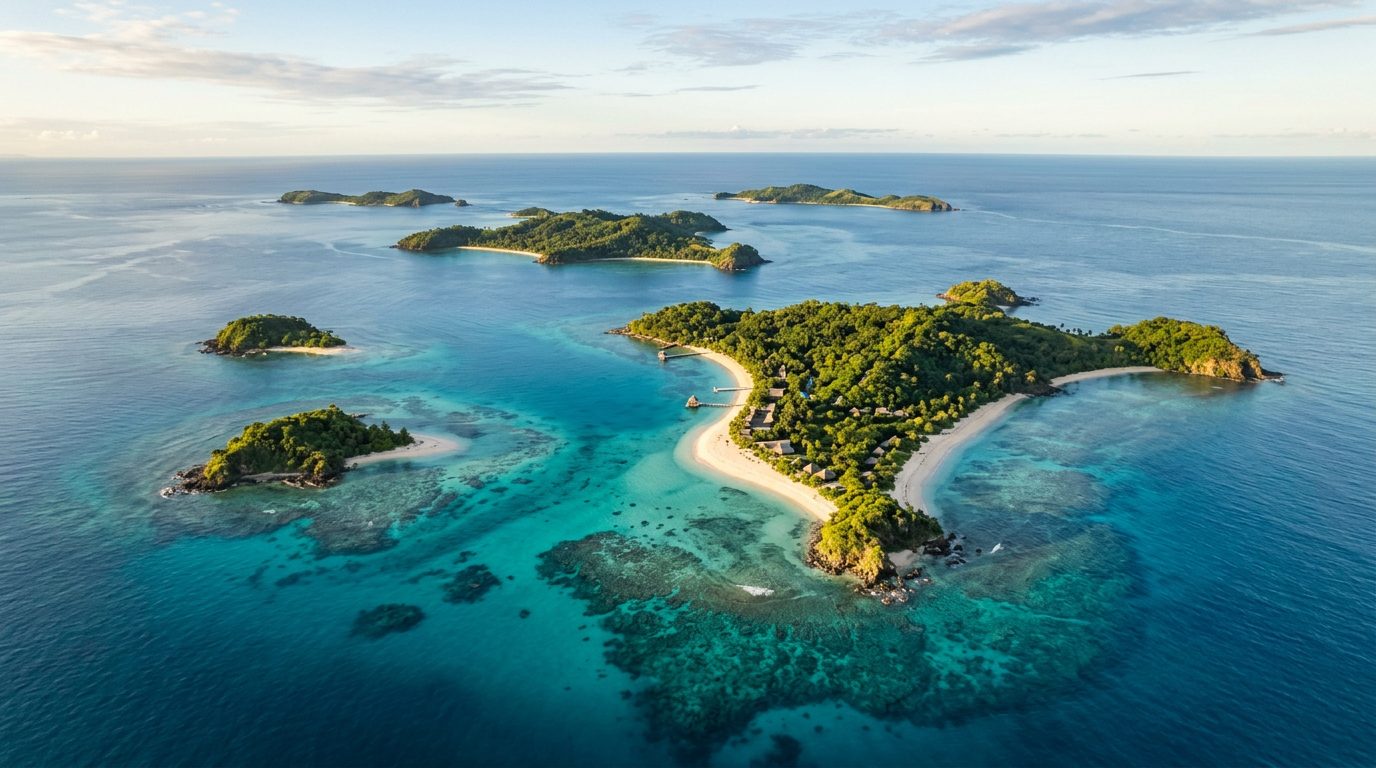
- Mamanuca Islands — 20 small islands just west of Nadi, the resort-and-pontoon scene
- Yasawa Islands — a 90 km chain north of the Mamanucas, the backpacker and island-hopping heartland
- Coral Coast — the southern strip of Viti Levu, family-resort country
- Denarau Island — man-made causeway-connected resort precinct near Nadi
- Taveuni — the “Garden Island”, rainforests and Rainbow Reef diving
- Kadavu — south of Viti Levu, home of Astrolabe Reef
- Beqa — small island south of the Coral Coast, the famous shark dive
- Lau Group — Fiji’s far east, largely uninhabited and almost unvisited
For most readers planning a first or second trip, only the first six matter. We break each down in detail below — and link out to our dedicated guides for the regions that need their own deep dive.
Choosing your region in one paragraph
If you have 5–7 nights and want short transfers, pick the Mamanucas. If you want to island-hop and meet other travellers, pick the Yasawas with a Bula Pass. If you are travelling with children and want a kids club, pick the Coral Coast. If you have already been to Fiji once and want something quieter, pick Taveuni or Vanua Levu.
The full reasoning behind each pick — and the trade-offs between them — is in the next sections. For a broader-trip overview, our Fiji travel guide covers itineraries, costs and logistics across the whole country.
On our last trip we ran a Mamanuca + Yasawa combination — three nights at Tokoriki, then five hopping the Yasawa Flyer up to Mantaray Island and back — and it remains our top recommendation for anyone with 8+ nights to spend.
The Mamanuca Islands
Where they sit
The Mamanucas (pronounced “ma-ma-NU-tha”) are a scattered group of about 20 small islands just west of Nadi, with transfer times from Port Denarau ranging from 20 minutes (Beachcomber) to about 60 minutes (Tokoriki). This is the resort-dense chain — Likuliku Lagoon’s famous overwater bures, the original “Cast Away” island (Monuriki, near Castaway Island Resort), and the Cloud 9 day-trip pontoon all sit here.
If you have seen Fiji on Instagram or in a tourism advertisement, there is roughly a 70% chance you were looking at the Mamanucas. The chain offers the largest concentration of overwater accommodation in Fiji and the easiest logistics for first-time visitors.
Boat transfers run several times a day from Port Denarau on the South Sea Cruises and Malolo Cat fleets — most resorts include the transfer in their nightly rate.
What it is like to stay here
Each Mamanuca island typically has one resort on it, so when you book a stay you essentially have the island to yourself plus 100 to 300 other guests. The smaller islands (Tokoriki, Vomo, Likuliku) feel intimate; the larger ones (Mana, Malolo) have a wider variety of activities and price tiers.
Day-trip pontoons run between the islands and from Port Denarau — the most famous is Cloud 9, a two-storey floating bar with a swim platform, run by South Sea Cruises. It is not subtle, but the wood-fired pizza at the upstairs bar is genuinely excellent.
Mamanuca house reefs vary widely. The reef at Castaway is one of the best in Fiji for shore snorkelling; the Likuliku house reef is better at low tide; Vomo’s beach drops steeply into deep water and is better for dive boats than snorkelling.
Best Mamanuca resorts at a glance
| Resort | Style | From / night (FJD) | Transfer |
|---|---|---|---|
| Likuliku Lagoon | Adults-only, overwater bures | 2,600 | 60 min boat |
| Vomo Island | Family-luxury | 1,800 | 50 min boat / 12 min heli |
| Castaway Island | Family / mid-luxury | 1,100 | 45 min boat |
| Tokoriki Island | Adults-only mid-luxury | 950 | 60 min boat |
| Malolo Island Resort | Family / mid-range | 650 | 50 min boat |
For the full ranking and resort-by-resort reviews, see our Mamanuca Islands guide.
The Yasawa Islands
The Yasawa Flyer and the Bula Pass
The Yasawas stretch 90 kilometres north of the Mamanucas — a long volcanic chain of narrow, hilly islands with white beaches, blue lagoons and a much smaller resort scene than the Mamanucas. The defining feature of travelling here is the Yasawa Flyer: a high-speed catamaran that runs the full chain daily from Port Denarau and stops at every accommodating island.
The Flyer is operated by Awesome Adventures Fiji. Pair it with a Bula Pass (5, 7, 9, 12 or 21-day tiers) and you have an open ticket to hop on and off at any island for the duration of the pass. A 7-day pass is roughly FJD 595 — for context, a single one-way transfer from Denarau to Naviti is around FJD 230, so the pass pays for itself after one round trip plus a hop.
Pair the Flyer with the Bula Combo Pass for an accommodation-and-meals add-on across the Awesome partner lodges. We have run this twice and it is the easiest way to do a multi-island Yasawa trip without spreadsheet-level planning.
Where to actually stay in the Yasawas
Most Yasawa islands have one or two lodges across a range of price tiers. The southern end (Kuata, Wayasewa, Waya) is closest to Denarau, easiest for short trips, and has the cheapest backpacker dorms. The middle of the chain (Naviti, Drawaqa, Tavewa) is the manta-ray belt and where most travellers spend the bulk of their time. The northern end (Nacula, Yasawa Island) is the most remote and has the smallest, quietest lodges.
Standout properties we have stayed at: Mantaray Island Resort (Drawaqa, dorms FJD 90 to private bures FJD 480), Barefoot Manta (Drawaqa, similar tier, adjacent dive centre), Naqalia Lodge (Wayasewa, locally run, FJD 130–250), and Yasawa Island Resort & Spa at the far north for a luxury bookend.
Our Yasawa Islands guide goes through every lodge worth booking, organised by location along the chain.
What you actually do there
The Yasawa rhythm is slower than the Mamanucas. A typical day: late breakfast, snorkel off the house reef, lunch, optional afternoon dive or village walk, sunset on the beach with a kava bowl. Most lodges run a half-day activity programme and a weekly lovo night.
The activity that lifts the Yasawas above almost everywhere else in Fiji is snorkelling with manta rays in the channel between Naviti and Drawaqa. Reef mantas pass through this channel from May to October on a daily basis, and Mantaray Island and Barefoot Manta run guided snorkel drops within minutes of a sighting. We have done this six times — it has never disappointed.
The other Yasawa highlight is the Sawa-i-Lau caves on the northern end of the chain — limestone sea caves accessible by boat, with a swim-through into an inner chamber. Most northern-Yasawa lodges run a half-day excursion.
The Coral Coast (Viti Levu)
What and where it is
The Coral Coast is the southern strip of Viti Levu — about 100 kilometres of coastline running from Natadola Beach in the west to Pacific Harbour in the east. It is on the main island, so no boat transfer is required: a 60–90 minute drive from Nadi airport gets you to most properties.
This is where many families and budget-conscious couples stay. The pricing tier sits below the Mamanucas for equivalent quality, the snorkelling at Natadola and along the Pacific Harbour-side reefs is excellent, and you get genuine Fijian village life close by — unlike the outer-island resort bubbles.
It is also the only major region where you can sensibly rent a car and self-drive between properties.
Who the Coral Coast is for
Families with children — Outrigger Fiji Beach Resort and Shangri-La Yanuca run the two largest, best-equipped kids clubs in the country. Both have shallow swim beaches and self-contained activity programmes.
Budget travellers — Mango Bay Resort and Bedarra Beach Inn both offer mid-range bures from FJD 250–400/night, well below comparable outer-island rates.
Day-trippers — the Sigatoka Sand Dunes National Park, the Naihehe Cave tour, and Pacific Harbour’s adventure-tourism cluster (white-water rafting, shark dives at Beqa Lagoon) all run as half-day or full-day trips from any Coral Coast base.
What about Denarau Island?
Denarau Island is a separate enclave just west of Nadi — a man-made causeway-connected resort precinct of six chain-brand hotels (Hilton, Sheraton, Westin, Sofitel, Radisson, Wyndham), a marina and a small commercial centre. It is convenient, well-maintained and slightly soulless. Most Fiji veterans skip it.
Denarau works as a single buffer night before or after an outer-island stay — it is 20 minutes from Nadi airport and 5 minutes from Port Denarau where the outer-island boats depart. If you are landing late or have a 6am Yasawa Flyer departure, a Denarau night saves the early-morning rush.
For full Coral Coast detail, see our Coral Coast guide; for the Denarau angle, our Denarau Island guide.
Taveuni, Vanua Levu and the Outer Islands
Taveuni — the Garden Island
Taveuni is Fiji’s third-largest island and arguably its most beautiful. The interior is rainforest, with the Bouma Falls trail offering one of the country’s best half-day walks. Offshore, the Rainbow Reef in the Somosomo Strait holds the famous Great White Wall dive site — a vertical drop covered in white soft coral that fluoresces under the right light.
Taveuni’s resort scene is small — Paradise Taveuni, Garden Island Resort, Maravu and a handful of dive-focused lodges. Most visitors fly in on Fiji Link from Nadi (about 90 minutes, FJD 320 one-way) and spend 5–7 nights.
This is a second-trip island. The diving is the main draw, and if you are not a diver you may find the resort options thin compared to the Mamanucas.
Vanua Levu and Savusavu
Vanua Levu’s main town is Savusavu, a deepwater yacht harbour and the gateway to Namena Marine Reserve — one of the South Pacific’s best macro dive sites. The Cousteau Resort (owned by Jean-Michel Cousteau) is the marquee property; Daku Resort and a handful of smaller dive lodges fill out the rest.
Vanua Levu is genuinely quiet. You can drive its main road for an hour without seeing another tourist. The eastern half of the island (toward Labasa) is rarely visited by leisure travellers and rewards the curious.
Fiji Link runs from Nadi to Savusavu (~75 minutes, FJD 280 one-way). For longer Taveuni/Savusavu combinations, the Lomaiviti Princess ferry from Suva is an inexpensive overnight option but is not recommended in rough weather.
The further-flung: Kadavu, Beqa and Lau
Kadavu sits south of Viti Levu and is home to the Great Astrolabe Reef — the fourth-largest barrier reef in the world. The two main lodges (Matava and Kadavu Koro Tabu) are small, off-grid and focused on diving. Reaching Kadavu means a Fiji Link flight from Nadi (FJD 350 one-way) followed by a 30–45 minute boat transfer.
Beqa Island is famous for one thing: the Beqa Lagoon shark dive, a baited bull-shark and tiger-shark encounter run out of Beqa Adventure Divers. The island itself has only two resorts (Lalati and Beqa Lagoon Resort) and is otherwise a quiet stop best done as a day trip from Pacific Harbour.
The Lau Group in Fiji’s far east — Lakeba, Vanua Balavu and others — is mostly off-limits to standard tourism. Visiting requires permits, advance arrangements and either a long flight or a multi-day boat trip. Worth the effort once you have done the rest of the country.
Frequently Asked Questions
How many islands does Fiji have?
Fiji has 333 named islands. Around 110 are permanently inhabited. The two largest — Viti Levu and Vanua Levu — together hold about 87% of the population. The rest of the islands range from small resort-only motus to substantial volcanic islands like Taveuni and Kadavu.
Which Fiji island is best for honeymoons?
The Mamanucas — specifically Likuliku Lagoon, Tokoriki Island, or Vomo — are the easy first answer for overwater bures and adults-only resorts. For longer honeymoons, combine a Mamanuca stay with a Taveuni or Yasawa segment to add some range. See our Fiji honeymoon guide for the full shortlist.
Which Fiji island is best for families?
The Coral Coast (Outrigger Fiji, Shangri-La Yanuca) and Castaway Island Resort in the Mamanucas. Both have established kids clubs, shallow swim beaches, and resort-paced activity programmes that suit travelling with under-12s.
Which Fiji island is best for backpackers?
The Yasawa Islands with a Bula Pass, hands down. Hostels like Mantaray Island Resort, Barefoot Manta and Naqalia Lodge offer FJD 80–150 dorm beds with full board, and the Yasawa Flyer makes multi-island hopping easy.
How do I get between Fiji islands?
Within the Mamanuca and Yasawa chains, you use boats — South Sea Cruises and Malolo Cat for the Mamanucas, the Yasawa Flyer for the Yasawas. For Taveuni, Savusavu and Kadavu, you fly Fiji Link from Nadi. There are inter-island ferries (Lomaiviti Princess, Goundar Shipping) but they are slow and weather-dependent.
Are all Fiji islands inhabited?
No — only about a third of Fiji’s 333 islands are permanently inhabited. Many of the smaller Mamanuca and Yasawa islands host only a single resort, while the more remote Lau Group islands are home to small villages with no resort infrastructure at all.
About the author: Lucy Cameron is the founder and lead writer at Hideaway Fiji. Auckland-based, NAUI Advanced Open Water certified, Fiji visitor since 2017 — 8 of 9 major island groups travelled.