Last updated: 12 June 2026 · Written by Lucy Cameron
Scuba diving in Fiji is genuinely world-class — the country is one of the few that combines healthy soft coral, big pelagic encounters, and warm-water comfort across a wide range of sites. As a NAUI Advanced Open Water diver with logged dives at every major Fiji site, here is the working guide to where to dive, when, and with which operator.
Key Takeaways
- Top dive sites: Rainbow Reef (Taveuni), Beqa Lagoon shark dive, Manta Channel (Yasawas), Astrolabe Reef (Kadavu), Namena Marine Reserve.
- Two-tank dive day: FJD 220–280 (USD 100–125) at most operators.
- Best visibility July–October (25–30 m); manta season May–October.
- All major operators are PADI or SSI affiliated; safety standards are high.
- For non-divers, the PADI Discover Scuba intro dive is FJD 250–350 at most resorts.

Fiji’s Top Dive Sites
Rainbow Reef and the Great White Wall (Taveuni)
The Rainbow Reef in the Somosomo Strait between Taveuni and Vanua Levu is Fiji’s most celebrated dive region. The marquee site, the Great White Wall, is a vertical drop covered in white soft coral that fluoresces electric blue at the right depth and light angle. Currents are typically moderate; depths 15–35 metres.
The Purple Wall, Annie’s Bommies and Jerry’s Jelly round out the standout Rainbow Reef sites — all accessed via Garden Island Resort, Taveuni Dive, or Maravu Dive. Two-tank day FJD 250.
Best visibility: July–October. Plan 4+ dive days to do the reef justice.
Beqa Lagoon shark dive
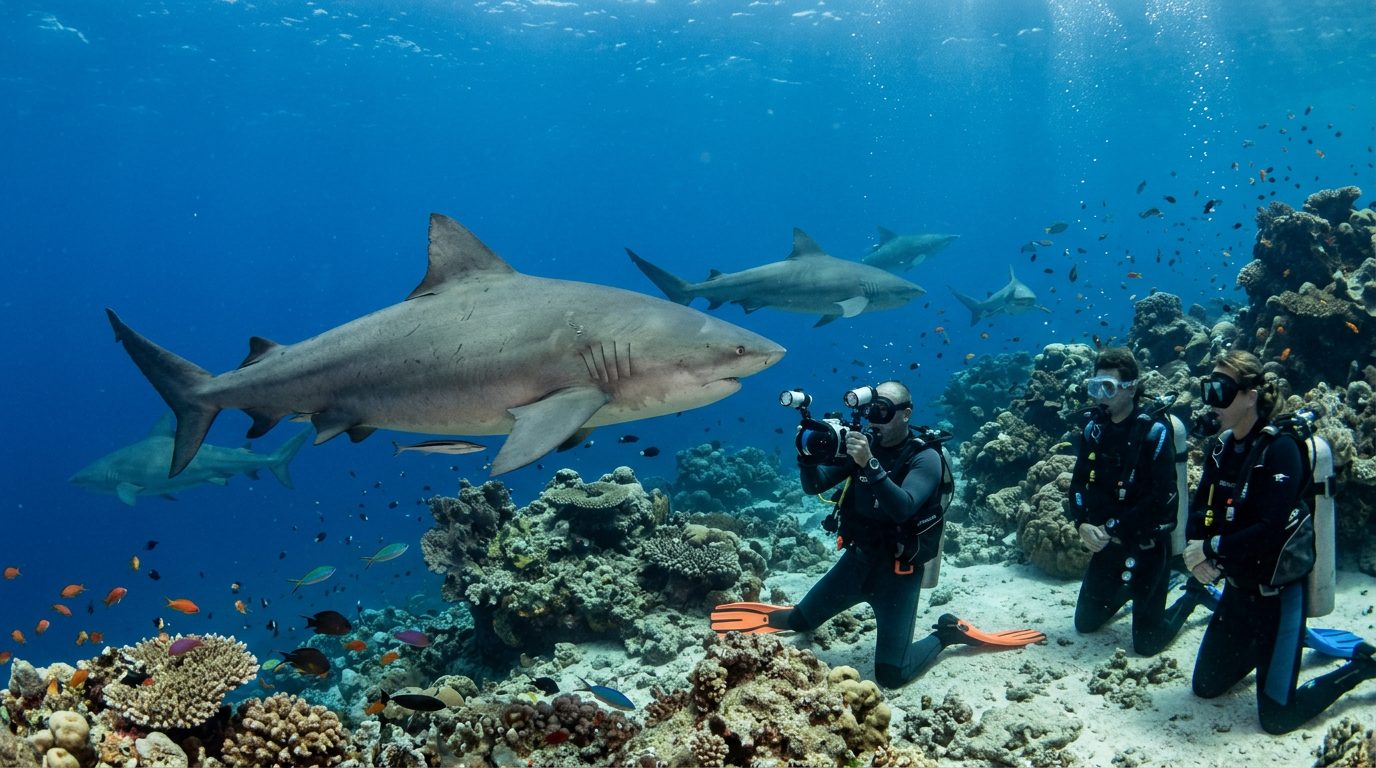
The Beqa Lagoon shark dive is the country’s most famous single dive — a baited two-tank encounter at 20–30 metres with 6–8 species of shark including bull sharks, tiger sharks, lemon sharks, and blacktip/whitetip reef sharks. Operated by Beqa Adventure Divers out of Pacific Harbour.
It is professionally run — long-time staff, conservation focus, the operator funds the surrounding marine reserve through dive fees. Open Water certified divers can join; AOW recommended for the comfort with the depth.
Cost: FJD 330+ for the two-tank day including transfers from Pacific Harbour. Book at least 5 days ahead in peak season — it sells out.
Manta Channel (Yasawas)
The manta channel between Naviti and Drawaqa is primarily a snorkel site but also runs as a drift dive in the right tide. Mantaray Island Resort’s dive shop and Barefoot Manta both run guided drifts at 8–15 metres when conditions align.
Season: May through October, peaking July to September. Two-tank day FJD 220 from Mantaray Island or Barefoot Manta.
The dive experience is faster-paced than the snorkel — you cover more ground but spend less time with each manta. For a pure manta encounter, the snorkel is the better choice. For diving plus the chance of a manta, the drift dive wins.
Astrolabe Reef (Kadavu) and Namena Marine Reserve
The Great Astrolabe Reef is the world’s fourth-largest barrier reef — 100 kilometres of fringing coral around Kadavu. Excellent visibility, fewer divers than Taveuni or Beqa, and consistently strong reef-shark and turtle encounters. Two-tank day FJD 250 at Matava or Kadavu Koro Tabu.
Namena Marine Reserve, near Savusavu (Vanua Levu), is the country’s longest-protected marine reserve. World-class soft coral, schooling fish, and reliable hammerhead sightings on the outer reef sites. The Jean-Michel Cousteau Resort runs the most professional Namena dive programme. Two-tank day FJD 260.
Both regions require a Fiji Link flight from Nadi plus a boat transfer to the lodge. Plan 5+ nights to make the travel worthwhile.

Dive Operators by Region
Mamanucas and Yasawas
- Castaway Divers (Castaway Island Resort) — PADI 5-star, runs Gotham City, Plantation Pinnacle, the Supermarket. FJD 230 two-tank
- Malolo Divers (Malolo Island Resort) — PADI, family-friendly, runs the Big W and Tokoriki Wall
- Mantaray Island Resort dive shop — SSI affiliated, manta-channel drifts
- Barefoot Manta dive shop — manta-channel and Drawaqa pinnacles
- Sub Surface (Treasure Island) — PADI, longer-tank days for advanced divers
All Mamanuca and Yasawa operators include weights, tanks and air-fills in their pricing. Gear rental adds FJD 60–90 per day.
Taveuni and Vanua Levu
- Garden Island Resort dive shop — PADI, the longest-running Rainbow Reef operator
- Maravu Plantation dive — PADI, smaller dive boats, more personal attention
- Taveuni Dive (Paradise Taveuni Resort) — SSI, multi-day packages
- Jean-Michel Cousteau Resort dive — PADI 5-star, Namena Reserve focus
- Tides Reach Resort dive (Savusavu) — PADI, macro focus
All Taveuni and Vanua Levu operators require Fiji Link flights to reach.
Pacific Harbour and Kadavu
- Beqa Adventure Divers — the shark dive specialists, PADI 5-star, conservation-led
- Aqua-Trek Beqa — PADI, broader Beqa Lagoon sites beyond the shark dive
- Matava Resort (Kadavu) — PADI, Astrolabe Reef base
- Kadavu Koro Tabu — SSI, smaller scale, dive-and-stay packages
Most of these operators bundle dive packages with accommodation — often the best value approach when committing to a region.
Planning Your Fiji Dive Trip
Certifications and what you’ll need
Open Water certification is sufficient for most Fiji sites. Advanced Open Water (AOW) recommended for the Beqa shark dive (depth), Namena outer reef sites (current), and Astrolabe Reef walls. Nitrox is offered at all major operators (FJD 40 supplement per tank).
Bring your certification card, a recent dive logbook (some operators ask), and a dive insurance card (DAN highly recommended for any serious Fiji dive trip).
If you are training, Fiji is an excellent place to do Open Water or AOW certification — calm conditions, multilingual instructors, FJD 950 for Open Water and FJD 750 for AOW at most operators.
Gear — bring or rent
Most operators include weights, tanks and air-fills in the dive price. Gear rental (BCD, regs, computer, fins, mask, snorkel, 3 mm wetsuit) adds FJD 60–90 per day.
If you have your own BCD, regs and computer, the savings stack up over a 4–5 day dive trip. Wetsuits are widely available; a 3 mm shorty works year-round, a 3 mm full wetsuit is more comfortable July–September.
Bring spare batteries, a torch (mandatory for night dives at Mantaray and Castaway), and a save-a-dive kit (mask strap, mouthpiece, O-rings).
When to dive and how long to stay
Best season: July through October. Visibility tops 30 metres at major outer reef sites, currents are predictable, water at 25°C (cool enough for a 3 mm wetsuit, warm enough for long dive days).
Shoulder months (May, June, September late): excellent conditions, lower demand, better resort rates. Our recommended sweet spot for a dive-focused trip.
Wet season (Nov–Apr): occasional river-runoff visibility drops, but Taveuni and Beqa sites recover within 48 hours of a storm. We have had outstanding February and March dive trips.
Frequently Asked Questions
Where is the best diving in Fiji?
Rainbow Reef (Taveuni) for soft coral walls. Beqa Lagoon for the shark dive. Namena Marine Reserve (Vanua Levu) for marine biodiversity. Astrolabe Reef (Kadavu) for the world’s fourth-largest barrier reef. Manta Channel (Yasawas) for seasonal mantas.
How much does diving in Fiji cost?
Two-tank dive days run FJD 220–280 (USD 100–125) at most operators. Gear rental adds FJD 60–90 per day. The Beqa shark dive is FJD 330+. Multi-day packages typically discount the per-day cost by 10–15%.
What certification do I need to dive in Fiji?
PADI/SSI/NAUI Open Water for most sites. Advanced Open Water for Beqa shark dive (depth), Namena outer reef sites (current), and Astrolabe walls. Discover Scuba intro dives are available at all major resorts for non-certified divers (FJD 250–350).
Are there shark dives in Fiji?
Yes — the Beqa Lagoon shark dive at Pacific Harbour is Fiji’s signature shark encounter. 6–8 species including bull sharks, tiger sharks, lemon sharks. Operated by Beqa Adventure Divers and Aqua-Trek Beqa. Book 5+ days ahead in peak season.
When is the best time to dive in Fiji?
July through October for peak visibility (25–30 m) and full manta season. May and September offer the best combination of conditions and value. Wet-season diving (Nov–Apr) is still excellent but carries occasional visibility drops after heavy rain.
Can I learn to dive in Fiji?
Yes — every major resort offers PADI/SSI Open Water (FJD 950) and AOW (FJD 750) courses. Conditions are excellent for training: calm lagoons, warm water, multilingual instructors. Discover Scuba intro dives (FJD 250–350) are available for non-certified visitors.
About the author: Lucy Cameron, NAUI Advanced Open Water, PADI Nitrox. Dives logged at Rainbow Reef (Taveuni), Beqa Lagoon, Manta Channel, Astrolabe Reef and the Mamanuca outer sites.